
Introduction
UPS systems protect critical loads from outages, voltage disturbances and poor supply quality.
Selecting a UPS is not only a capacity exercise. A reliable design considers the actual load, the business impact of downtime, the required battery autonomy, maintainability, environmental conditions and the way the UPS will be isolated or bypassed during service.
For commercial and critical infrastructure environments, the best UPS design is usually the one that remains safe, serviceable and scalable over the life of the facility. That means the early design decisions matter: topology, battery architecture, bypass arrangements and space planning all affect long-term reliability.
Define the Critical Load
The critical load is the equipment that must remain operational during an outage or supply disturbance. It may include servers, network switches, security systems, access control, medical systems, process control equipment or selected business-critical workstations.
Information required before sizing
- Equipment list with rated watts, kW or kVA where available.
- Measured load data if the installation already exists.
- Single-phase or three-phase supply arrangement.
- Expected future growth over the next three to five years.
- Loads that must be excluded from UPS supply, such as air-conditioning compressors or non-essential sockets.
Select the Right UPS Topology
Different UPS topologies suit different risk profiles. Smaller office loads may tolerate simpler protection, while server rooms, production systems and healthcare environments usually require online double-conversion UPS technology.
- Line-interactive UPS units are suited to smaller, less critical loads.
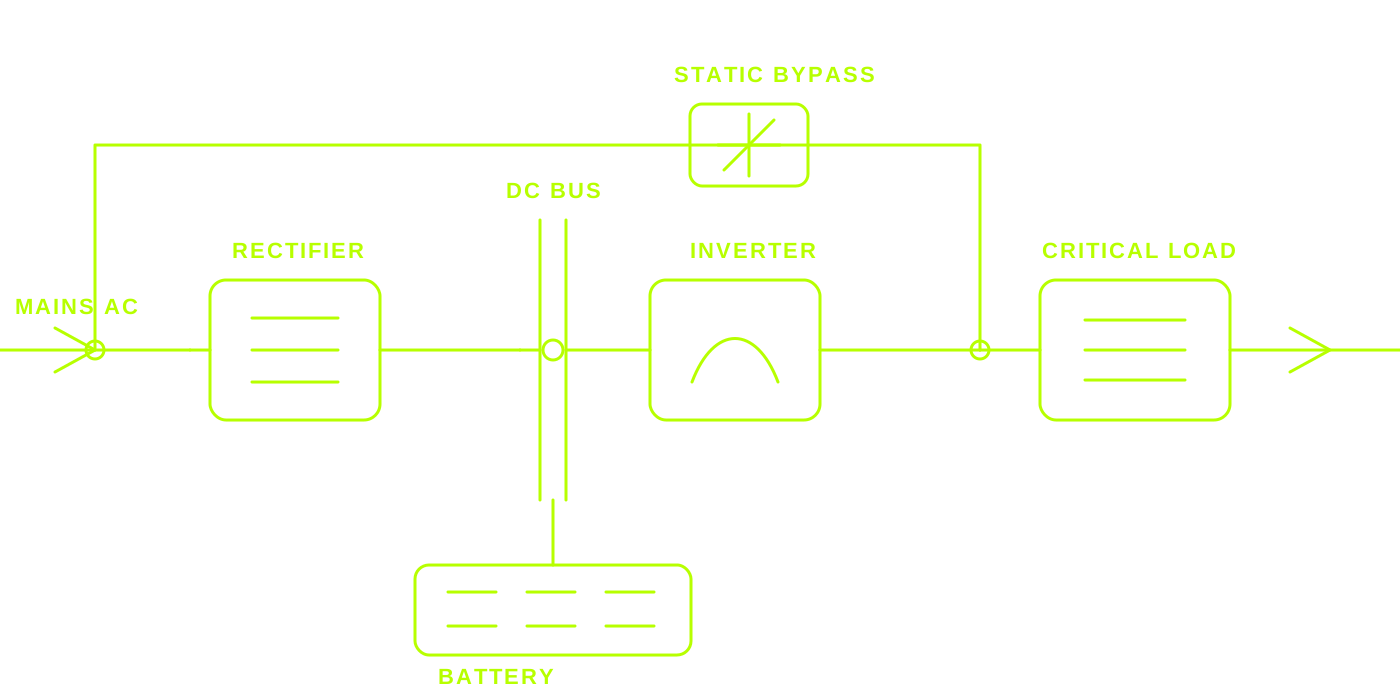
- Online double-conversion UPS systems provide continuous power conditioning for sensitive or critical equipment.
- Modular UPS systems support scalable capacity and maintainability where future growth is expected.
- Redundant UPS configurations can improve availability where downtime risk is unacceptable.
Calculate Design Capacity
Once the real load is known, the design capacity should allow for power factor, growth margin, redundancy and manufacturer operating recommendations. Many UPS systems are rated in kVA, but the usable real power capacity depends on the UPS output power factor.
- Convert measured or listed loads into kW where possible.
- Apply a sensible design margin, commonly 20–30% depending on growth expectations.
- Check the selected UPS kW rating, not only the kVA rating.
- Confirm input current, charger allowance and upstream protection requirements.
Plan Battery Runtime
Battery runtime depends on load, battery quantity, battery type, temperature, age, discharge rate and UPS efficiency. Short UPS runtimes place batteries under high-rate discharge conditions, so amp-hour capacity cannot be used as a simple linear energy figure without correction.
- Define the required autonomy in minutes.
- Confirm whether runtime must support generator start-up, safe shutdown or full operational continuity.
- Use manufacturer discharge tables for final battery selection.
- Allow for battery ageing and replacement planning.
Design for Maintainability
A UPS that cannot be isolated, accessed or safely maintained creates operational risk. Maintenance bypass arrangements, cable access, battery clearances, ventilation and safe working space should be part of the initial design.
Maintainability checklist
- External maintenance bypass provided where required.
- Safe isolation and labelling in place.
- Battery cabinets accessible for inspection and testing.
- UPS room ventilation and temperature controlled.
- Adequate clearance for module replacement and service work.
- Load testing and commissioning records retained.
Summary
A strong UPS design starts with a clear definition of the critical load and ends with a maintainable installation that supports the facility for years. The correct system is not always the largest system; it is the one that matches the risk, load profile, runtime requirement and operating environment.
Emerald’s approach is to assess the site, confirm the load, model the runtime requirement and select equipment around reliability, safety and lifecycle support.
Related resources
Continue planning
Calculator
UPS Runtime Workspace
Estimate UPS autonomy using load, battery configuration and design factors.
Open resource →Planning Tool
UPS Load Planning Workspace
Build a preliminary UPS load schedule and recommended equipment size.
Open resource →Reference Guide
UPS & Battery Systems Guide
Review UPS technologies, battery systems, runtime and lifecycle planning.
Open resource →The Emerald Approach
The Emerald Approach
Reliable critical power infrastructure begins with understanding the application, not simply selecting equipment.
Emerald assesses the operating load, required runtime, electrical infrastructure, generator integration, maintainability, site conditions and future growth before recommending a solution.
This practical, system-focused approach helps ensure that the complete installation remains reliable, serviceable and appropriate throughout its operational lifecycle.
Site assessment
Need help selecting the right UPS system?
Emerald can assess your critical load, runtime requirement, site constraints and maintenance strategy before recommending a practical UPS solution.